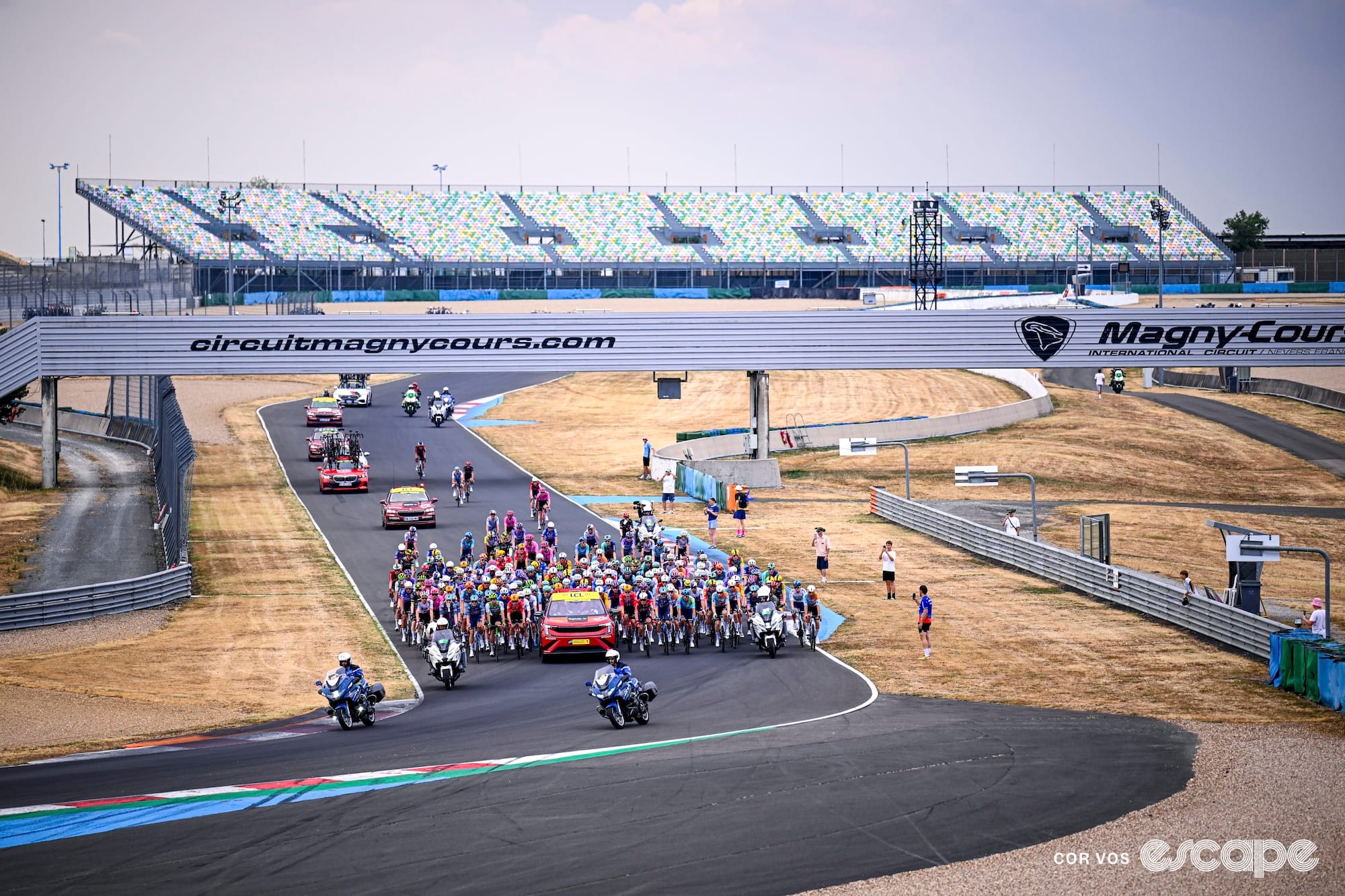


Today’s 12th stage of the Tour de France began at the Nevers Magny-Cours Formula 1 racing circuit. That’s “Magny” for short, if we trust the name spelled out in contrasting multicolored fiberglass seats against the predominantly black grandstands. That bit of branding was clearly visible in the backdrop of the stage depart, because almost nobody was sitting in the seats. Anyone who cared to be at the rollout was in the neatly corralled area near the start/finish gantry, under which riders would line up. Tightly framed, that made for a great, fan-filled shot, or at least one in keeping with a typical Tour start or finish. But the overall effect of the Magny start was underwhelming, and that’s not a surprise.
Using motor racing circuits for bike races is not new – quite the opposite. The first professional world road race championship, won by Alfredo Binda, was held on a nascent version of Germany’s famed Nürburgring in 1927. Seventy-five years later, Mario Cipollini won his rainbow stripes on the Zolder circuit in Belgium. Stage 3 of the 2017 Tour de France passed through a piece of the Spa-Francorchamps circuit, and Stage 4 of the 2023 Tour finished on the Circuit Paul Armagnac in Nogaro, near Pau. Magny itself hosted a Paris-Nice stage start in 2014 and a start for ASO’s new-look TTT format last season. Apparently, Magny makes a convincing pitch.
It’s easy to see the appeal for race organizers, especially when compared to a barren ski station or, say, a mid-sized town in the Massif Centrale. Purpose-built tracks come with space and infrastructure, from power to communications to access to ample parking for fans and teams. Their management is already tied into the local promotional and media environments. Entrance and egress are already optimized to not disrupt all aspects of life within a 30 kilometer radius. Many things that need to be fenced and signed are already fenced and signed. The tarmac is good. They have bathrooms.
Sounds great, what’s the issue?
It’s not all flush toilets and parking lots, though, and the disadvantages – for fans, for riders, for racing – are also apparent to the naked eye. Access to an entire venue built around the fan experience might seem like a dream scenario for a nomadic sport that’s used to being hastily retrofitted into towns and fields and mountains, but as it turns out, it isn’t. Because racing circuits aren’t built for cycling’s fan experience. A few examples:
Did we do a good job with this story?