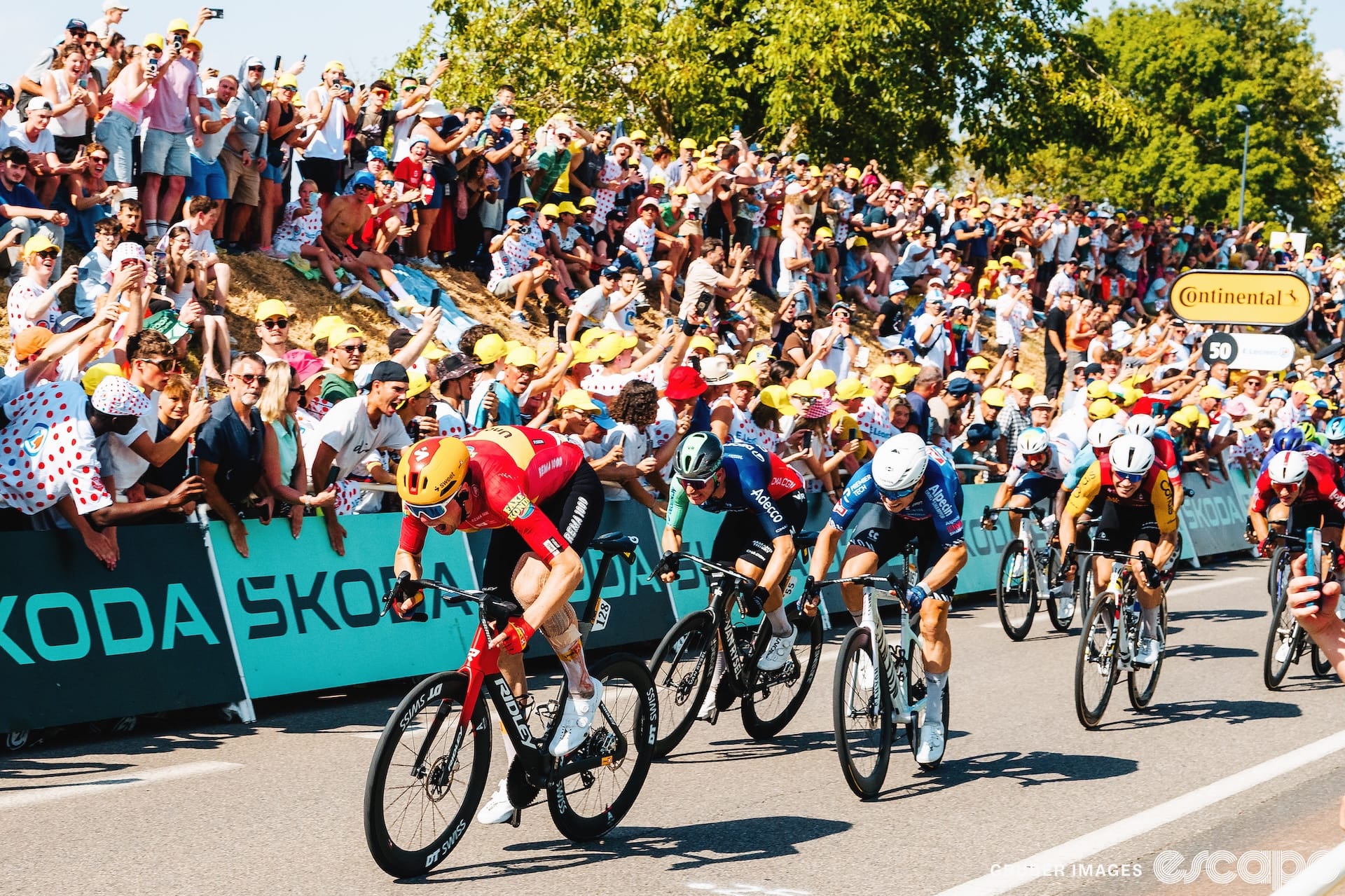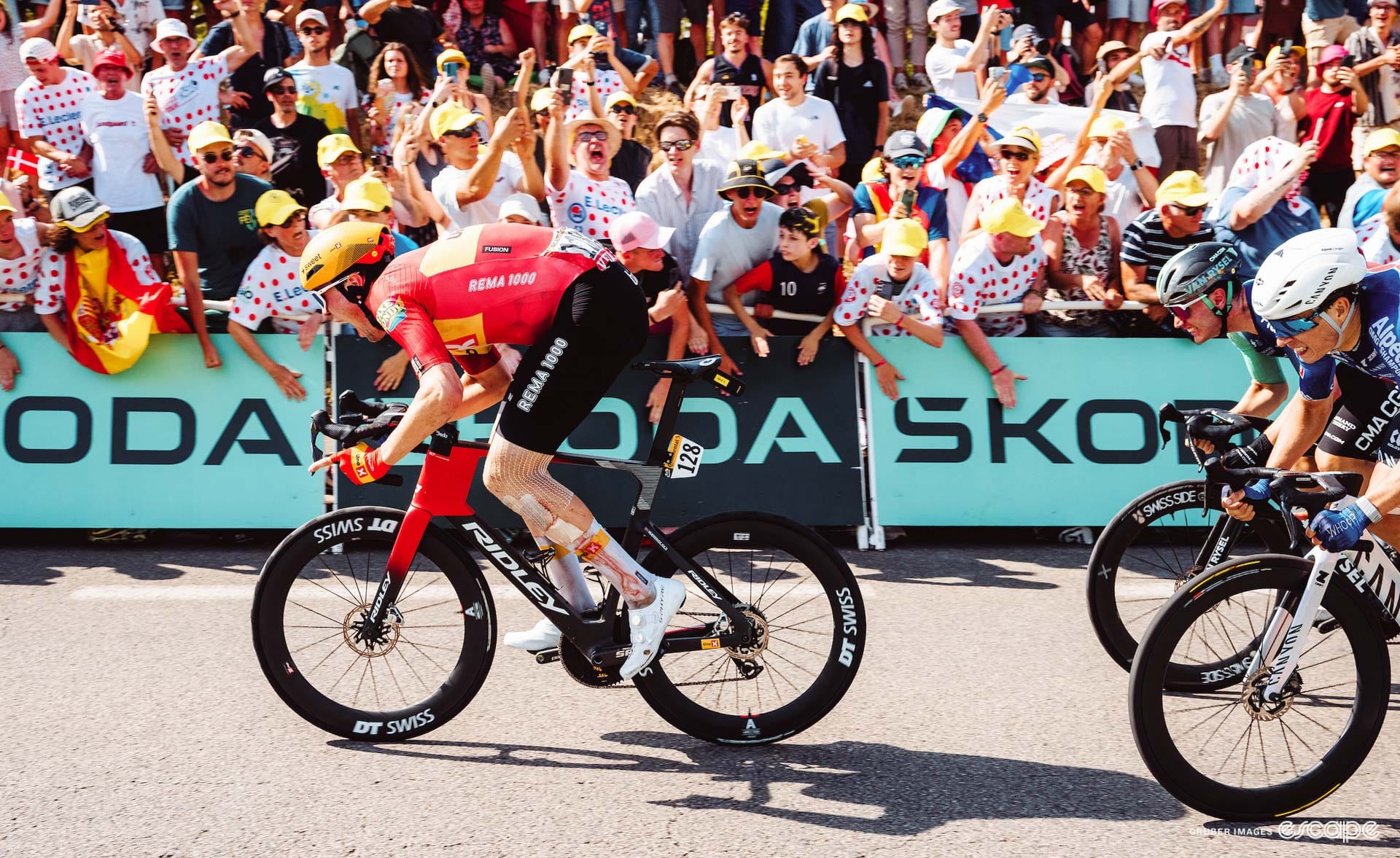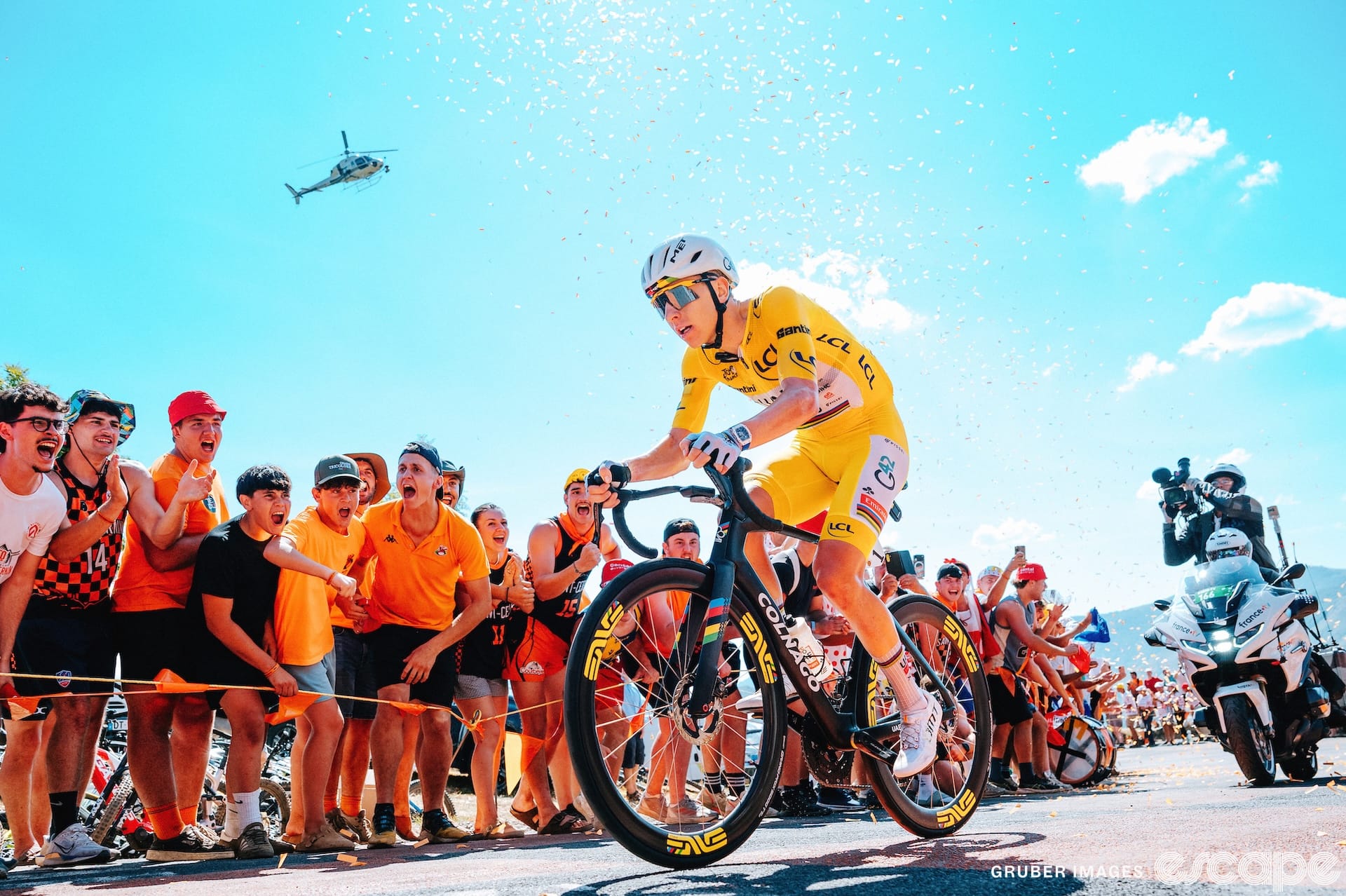


It's stage 20 of the 2039 Tour de France, and as a tense, close fight for the yellow jersey goes down to the wire, French phenom Julien Bordelieu attacks on the iconic barren slopes of Mont Ventoux. Sweat dripping from his chin, he rounds the final corner alone and surges across the line, arms spread in a wide cruciform before he slumps over his handlebars in exhaustion, having overhauled Belgian and defending champion Sebastian Van Damme for the race lead. All that stands between Bordelieu and the win is Sunday's ceremonial final stage.
On the TV coverage, emojis light up the screen, a virtual confetti shower of applause. Bordelieu rips off his full-wrap VR shades as a soigneur hands him a towel. He dismounts his stationary bike and moves to the recovery room for his flash winner's interview for the TV coverage.
It's the second edition of a fully virtual Tour. The shift began six years before that, when raging drought-fueled wildfires in southern France threatened to force the cancellation of four stages in a row, and MyWhoosh stepped in with a novel solution: A hastily converted aircraft hanger in Toulouse, 176 stationary bikes airfreighted in overnight, and a real-time encore to the first virtual Tour de France held during the COVID-19 pandemic.
Tour organizer ASO tried everything since, or almost everything, to keep the race on the road: Earlier starts ran afoul of television audiences and ad revenue, the financial engine that powers the sport. There were routes that avoided the southern part of France entirely, and a foreign Grand Depart in Bergen, Norway, site of the 2017 World Road Championships. Innovative liquid-cooled textiles, like the Fremen stillsuits from Dune, solved thermoregulation issues when wet bulb globe temperatures routinely tipped into dangerous territory, but riders still suffered from smoke inhalation.
The last straw came in 2036, when a fast-moving conflagration swept up a mountainside toward panicked Tour fans trapped on a closed mountain pass with no way out. Three died, hundreds more suffered injuries in the stampede, and the ensuing legal actions nearly spelled the end of ASO altogether. After that, the Tour's ongoing experiments with online racing turned to replacing the real thing altogether.
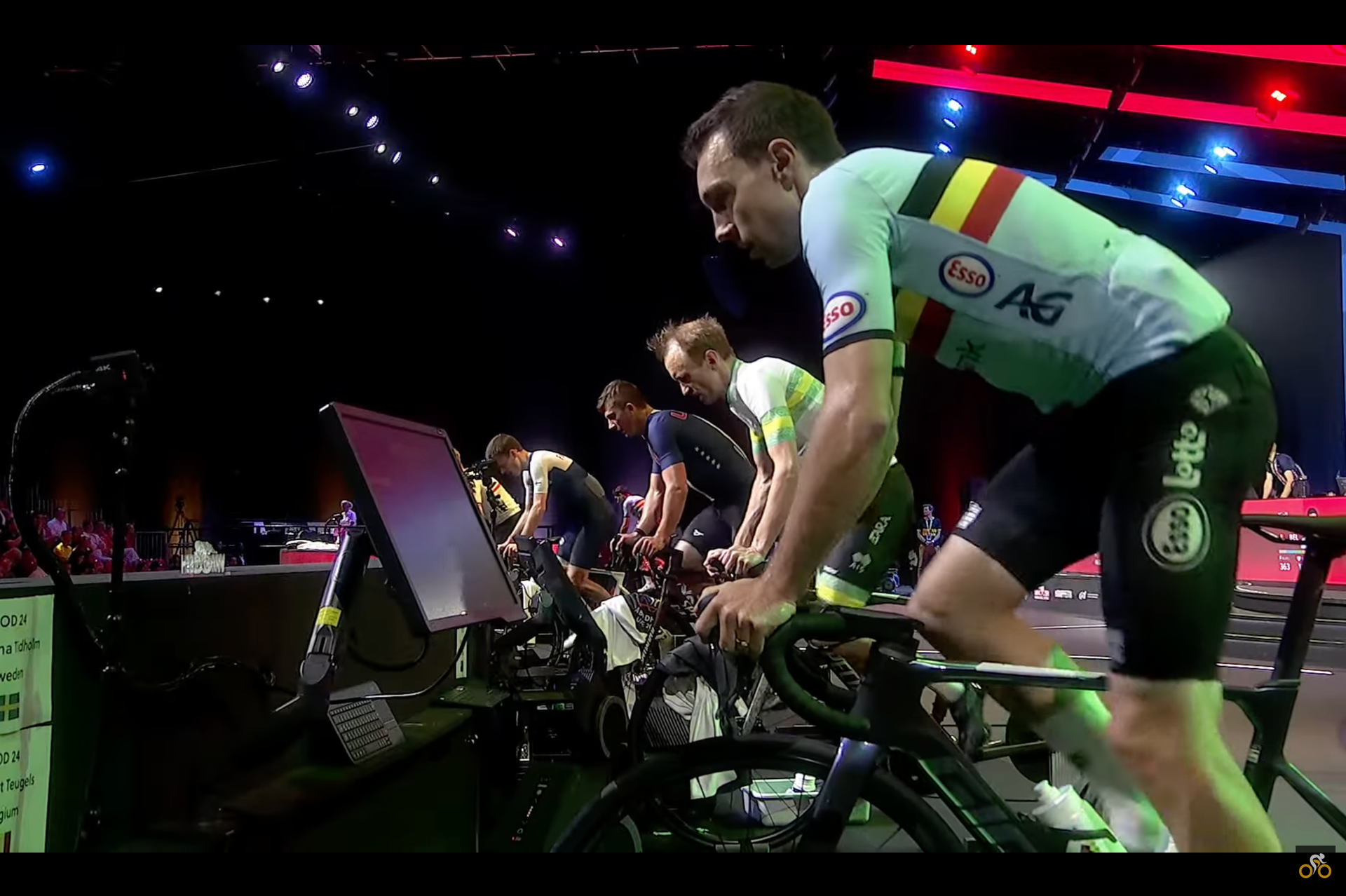
No one was sure a virtual Tour would work; whether the technological advancements in online racing – sophisticated real-time CdA algorithms that accounted for rider position and drafting; dynamic stationary platforms that allowed for true-to-life pack spacing and descending physics down to tire grip (and thus: crashes); and high-resolution virtual environments that felt faithful enough to the racers to make it seem like they were in a real-life peloton rocketing down passes in the Alps rather than sitting on trainers in an air-conditioned arena in Dubai – had progressed enough to allow for a realistic 21-stage race for riders and fans. But people accepted it, and now there's no going back. Not that we could if we wanted.
There's an alternate future of road racing, and it played out 13 years ago at the Tour of California. Stage 2 of the 2013 edition – four years after the race switched its dates to sunny May, hoping to escape California's dreary, wet February weather – was the epitome of hubris.
The stage started in Murrieta, one-time home of Floyd Landis, then recently famous for burning down the myth of Lance Armstrong's seven Tour wins and the truth of the doping program behind the US Postal Service team. On that day, however, the embers of the sport's past were not the focus. Riders traversed a desert route that took the pack high into the San Jacinto mountains before descending to the heat-blasted plain around Palm Springs.
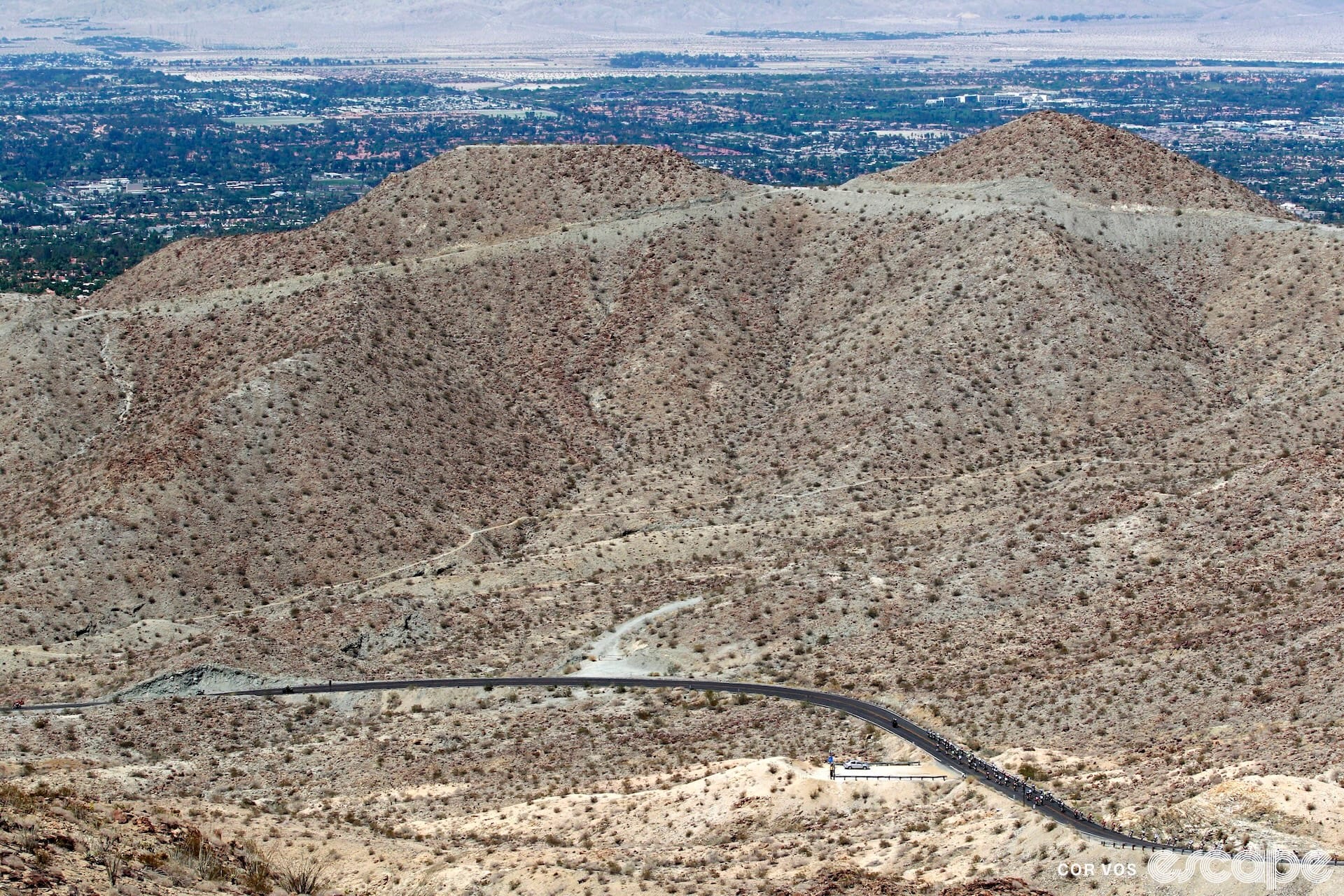
But instead of a sprint finish in town, riders went straight through and turned left for a steep climb to the aerial tramway parking lot. The road ascends almost 600 meters / 2,000 feet in around 5.6 km / 3.5 miles, with gradients up to 13%. Road crews had recently resurfaced it in a layer of fresh, deep-black tarmac.
Temperatures that day rose to 42° C [108° F]. Air temperatures a meter above the road surface were almost certainly higher. It was like riding inside a hair dryer, one rider later told me. The afternoon sun blazed down pitilessly on the treeless, shadeless ramps as the pack approached. Race staff, soigneurs, and journalists, sweating through our shirts, shifted foot to foot on the burning pavement as the TV helicopter drew near.
The lightly built Colombian climber, Janier Acevedo, was first across the line, with eventual overall winner Tejay van Garderen a few seconds behind as we journalists pressed in close for a quote. Below them, a long string of riders lay littered down the straight, steep drop to the valley floor. But as they began to cross the line in ones and twos, all thought of getting interviews vanished.
Did we do a good job with this story?