
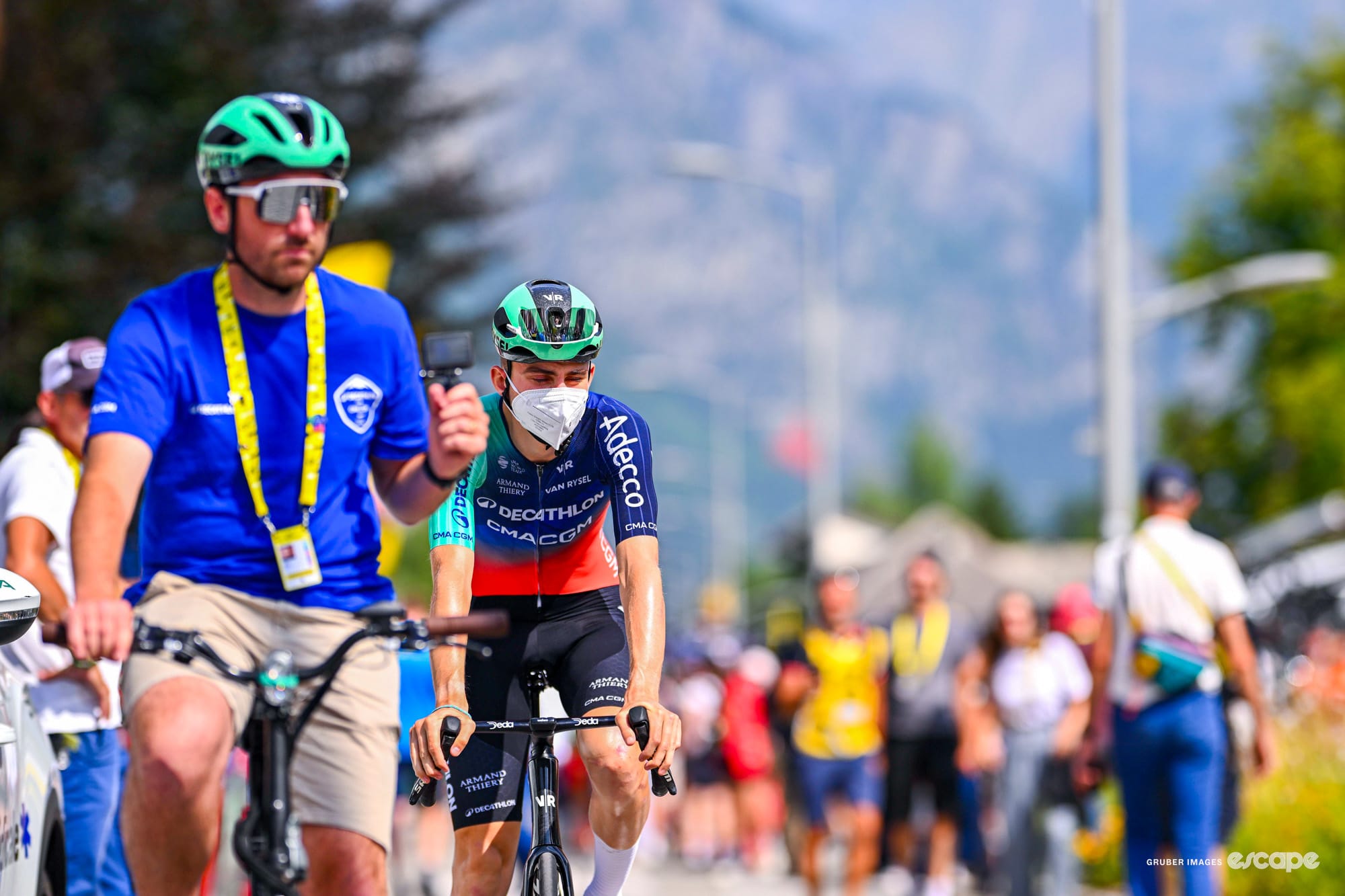
It took nearly 2,500 meters of climbing, an entire hors-catégorie climb, and most of the Col du Télégraphe before one of the biggest men in the peloton finally cracked. Daan Hoole, all six-foot-four of him, was still there when the GC group thinned to 80, then 50, then 40 — present, just in case, for whatever Paul Seixas might need. A year ago, Decathlon-CMA CGM would not, and probably could not, have put a rider like that in a place like that. They wouldn't have had a reason to. This year it can, and did, and this seemingly small act is crucial to the question of Seixas’ eventual home.
As the Tour de France wraps up with Seixas solidified in fourth, the smart money currently says nothing much is set to change. Another contract with Decathlon-CMA CGM looks increasingly likely. Some of that is pressure, from the sponsors, from the French press, from a French president who has made no secret of wanting the country's next great hope to stay on a French team. But beneath that pressure is something far simpler. Over three weeks in July, this team proved it might actually have the mettle to support a generational talent, and turned an abstract promise into something Seixas can see.
Seixas is not short of alternatives. A month ago, reports emerged that the billionaire backer of Pinarello-Q36.5 had tabled €13 million a year for him — a figure that would make a 19-year-old the best-paid rider in the sport. Netcompany-Ineos has been sniffing around, with its billionaire owner, albeit one more and more removed. And then there is UAE-Team Emirates, the state-funded goliath that already had two riders on this year's podium, connected to Seixas through agent leaks and a softer thread: his younger brother Nino, who spent time at a UAE training camp last year. Photos of Nino riding the same Colnago as Tadej Pogačar sent cycling fandom into a tizzy.
Against all that money and gravity stands Decathlon-CMA CGM, backed by two of the largest and most visible companies in France, trying to convince the future of French cycling to keep his eyes forward.
 Caley Fretz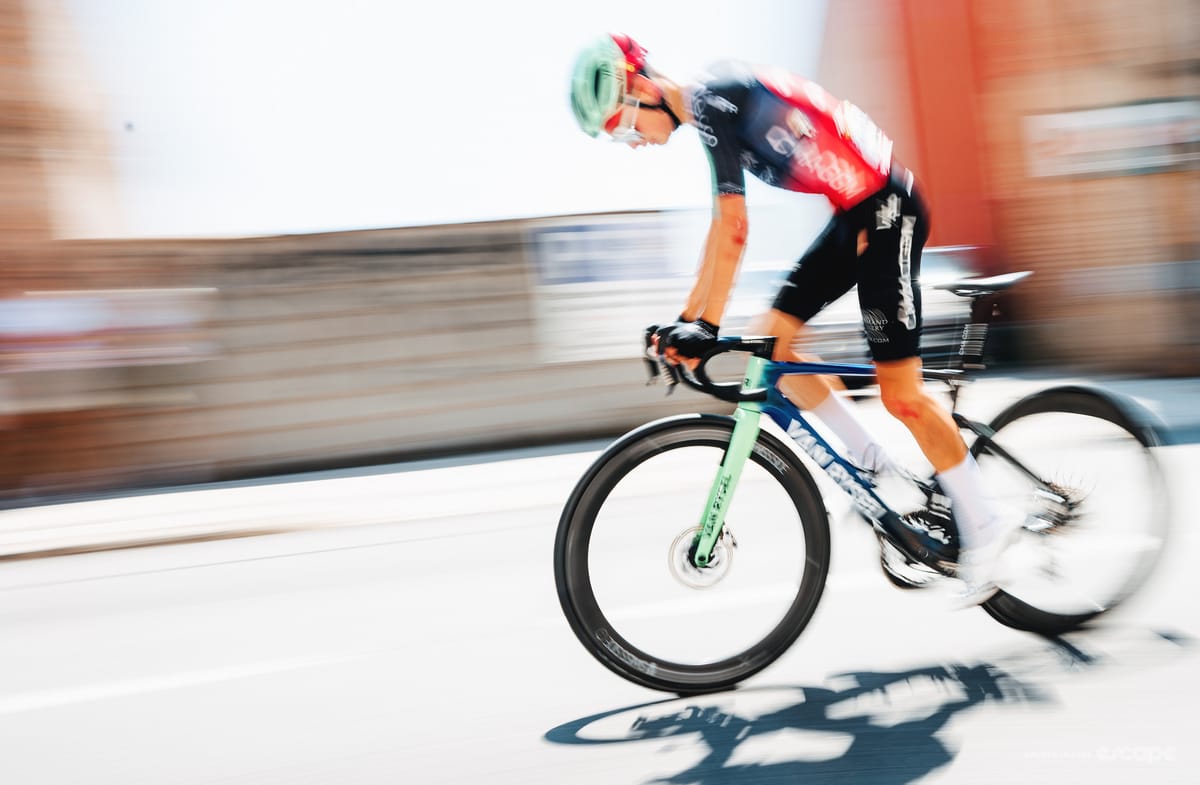
To do that, the team has to be more than a chequebook. Unlike UAE, the two vast French corporations behind this team will want a definable return on their investment, and that demand only grows as the spending does. Keeping Seixas means building a team worthy of him, including the support systems behind the riders. Everything from media handling to wind-tunnel optimization needs to be dragged up to the standard of the sport's superpowers as quickly as possible. Much of that upgrade is already visible at the Tour de France itself.
Decathlon's rise relative to its peers was visible daily through the Tour. On the morning of stage 7, in Hagetmau, twenty-one team buses crammed into the small town center under the heat still hanging over southern France. The two parked farthest from the sign-on stage were Decathlon and Netcompany-Ineos — the bus we used to call the Death Star.
For a decade, the Ineos bus, and Sky before it, drew a daily gaggle of reporters, TV presenters, and autograph hunters chasing Dave Brailsford or Chris Froome or a signature from Geraint Thomas. In Hagetmau, it sat silent. Riders came and went without fanfare; a director leaned against a grey team car and ate a pre-race sandwich, undisturbed. Thomas, now the team’s director of racing, sat in a team car with the door open, thumbing through his phone.
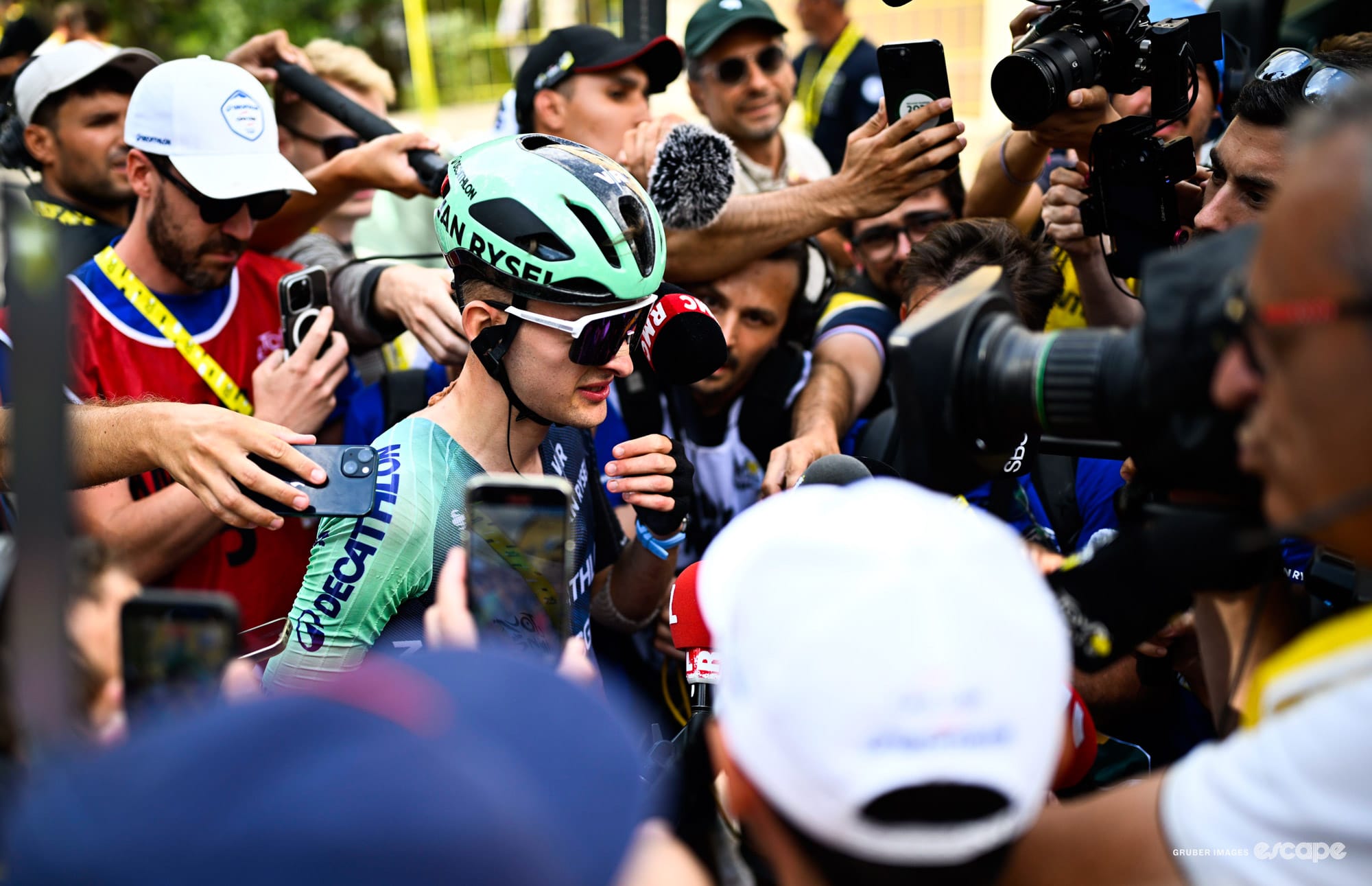
Twenty feet away, in a corner of the paddock drowning in Decathlon's blue, red and white, endless groups of VIPs shuffled through in minder-led clusters, taking selfies in front of the big logo and the riders' bikes. Little blue Decathlon flags stuck out of plastic pipes at every corner of the roped-off area, handed to any fan who wandered close, and there were hundreds of them. Pauline Ballet, a phenomenally talented French photographer normally contracted directly to the ASO during the Tour, snapped photos on her new assignment: inside Decathlon, following Seixas. A French radio reporter hovered, microphone near her mouth, in the same spot I'd seen her at every start and every finish all week; she is on permanent Paul-watch, she told me.
This was a team that brought a single press officer to last year's Tour, when both media and fan interest were middling at best. Not anymore. Now there are three, including one just to handle Seixas media inquiries (where the answer is almost always no) and another who rides with him to sign on each morning.
On one side of the little parking lot, the past. On the other, Decathlon’s vision of the future.
Support systems and staff
A collection of small moments like the one in the paddock in Hagetmau paint an optimistic picture of a squad rallying around its young, sought-after charge. But the pitch has to go deeper than paddock equipes theater. Decathlon has to pull out all the stops.
Did we do a good job with this story?