
The Tour de France starts this year on July 4, America's big day for cookouts. And if the general classification is the 15-hour smoked brisket of the Tour de France – the main course, the pièce du résistance, the headline act – then sprint finishes are the sides that threaten to steal the show. Did I just compare Jasper Philipsen to a potato salad? His Jasper Disaster persona does have a certain mustardy tang to it, and if you've had the particular potato salad I'm thinking of, then you know what I mean by show-stealer.
Sprints steal the show because they compress the drama of the Tour into a breathless few minutes of furious excitement, complete with all the elements that make bike racing unforgettable to watch. That doesn't mean they're necessarily straightforward to understand, however elemental is the fact that the first rider across the line wins.
Sprint stages often follow a similar template: There's an early breakaway, which the sprinters' teams then control by riding pace on the front to keep the gap manageable. They ramp up the pace to time the catch for 10-20 km left in the race, and then hit the gas the rest of the way to prevent counterattacks and keep their riders in good position in the pack. In the final few kilometers, the pace ratchets up to infernal levels – 60 km/h or more – and then there's a final, frenzied, mad dash for the line. Within each of those set pieces, there are all kinds of fascinating things that unfold in a sprint stage, sometimes in a split second, that are easy to miss even when they happen right in front of you.
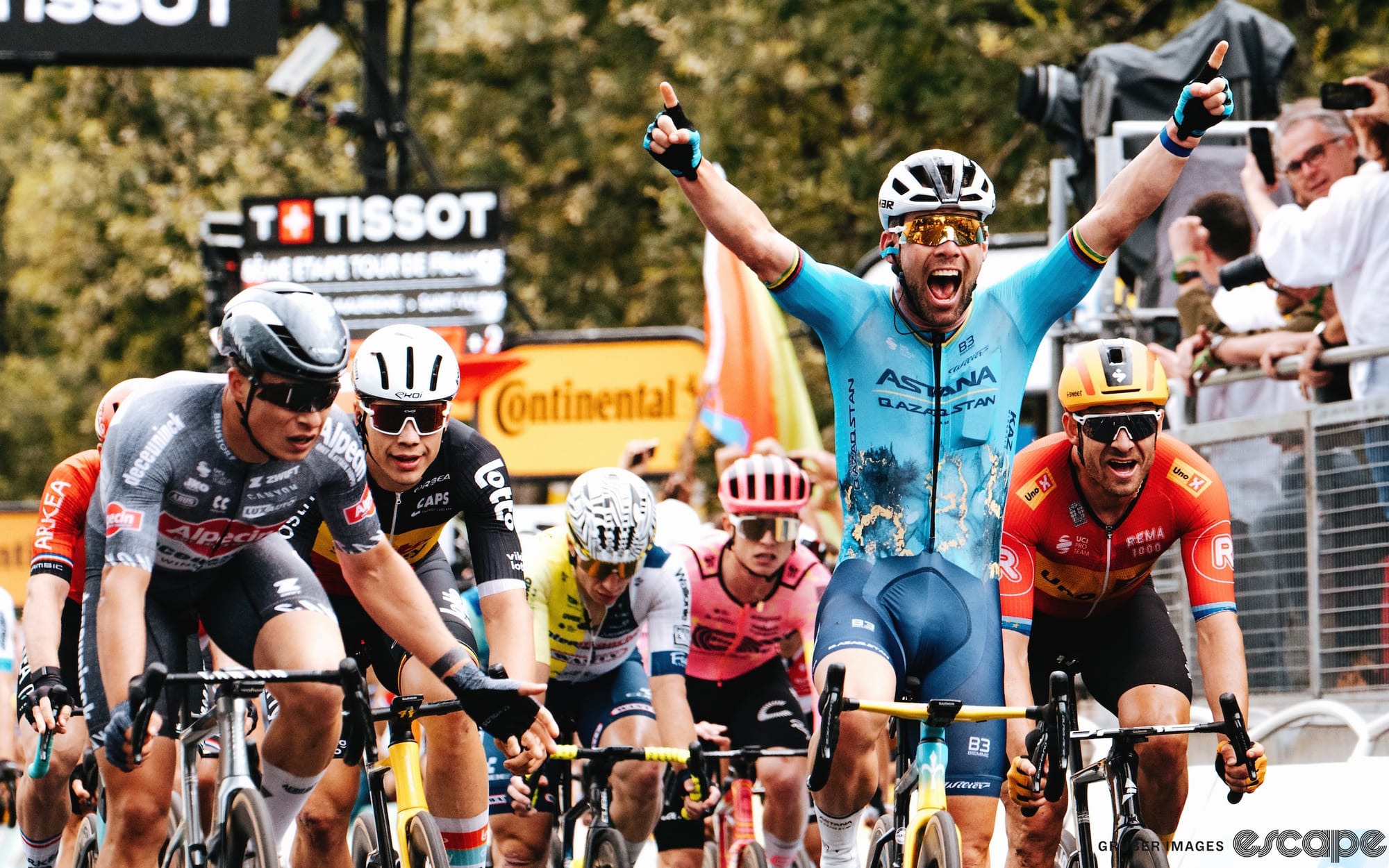
So today, we're gonna break down what goes down in a sprint stage, an Escape Collective's Quick and Easy Guide to Sprint Finishes, if you may. For our template, we'll use two stages from the 2024 Tour de France, including Mark Cavendish's record-setting stage 5 win and Jasper Philipsen's stage 16 victory, each of which illustrate vastly different ways to win a Tour sprint stage.
Sprint finishes part I: The virtuoso improviser
Before we get to the sprints themselves, a quick note about the preliminary action. Sprint stages can seem pretty static if you watch for more than a few minutes. The break is up the road, the pack some distance behind, and the coverage bounces back and forth to each group as the race traverses the first, say, 150 km. There are castle shots and long digressive asides by the commentators as they try to fill airtime. You've got the stream on but only half an eye on the action. How do you know when to pay attention? The easiest way is to simply watch the shape of the peloton. It can be alternately dull or sharp, and the difference tells you a lot about what's happening in the race.
So it was on the 177.4 km stage 5, from Saint-Jean-de-Maurienne to Saint-Vulbas, broken up only by a few mostly gentle climbs.
Sharp: Here the pack is stretched out in a long line. It's no more than a few riders wide. The sense of kinetic action is far higher; you can actually see the difference in speed. Riders jostle for position and try not to let a gap open. Here, it's Intermarché-Wanty (blue, yellow and white jerseys) driving the pace, and the background gives a hint as to why. The gap to the break is 1:35 and there's 54 km to go. No one is afraid of the break getting too long a leash here, so what's going on?
Did we do a good job with this story?