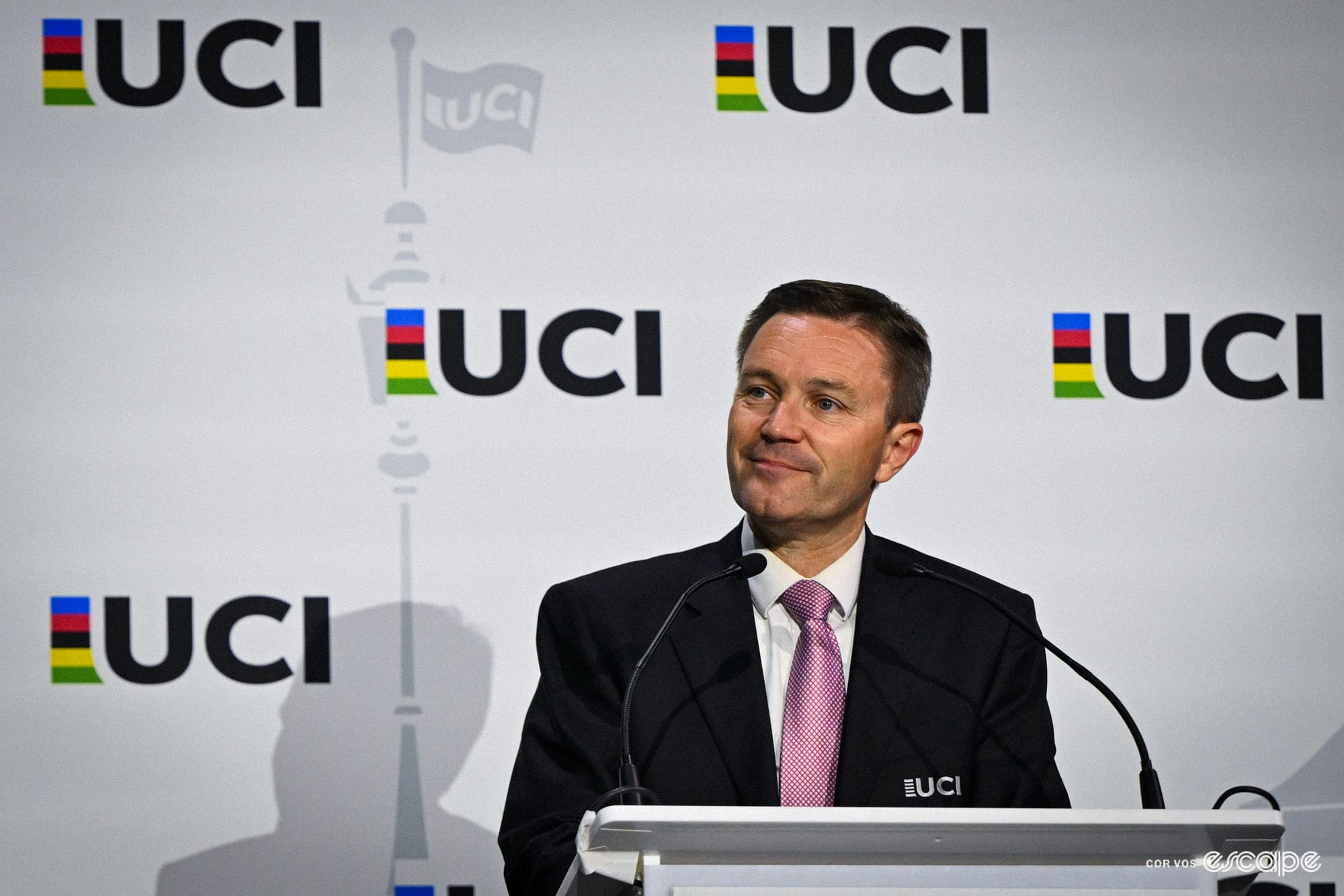

David Lappartient is now eligible for a fourth term as UCI President, courtesy of an extension of the maximum term limit that came as part of a raft of constitutional changes freshly introduced by cycling’s governing body.
The changes came into effect in the latest revision to the UCI Constitution, dated on the UCI website as September 25, 2025 – the same date as the UCI Congress in Kigali. The full proceedings are newly available online after a copyright infringement limited visibility for several weeks.
Multiple sources Escape Collective spoke to said they were unaware of the changes, which were unanimously passed by voting delegates at the Congress. There is some contention around the framing of the constitutional changes, which were introduced by Lappartient in his remarks at the Congress as a bid to increase consistency of governance across the UCI and its continental confederations.
One aspect alluded to by Lappartient was a goal to “clarify the term limits for the UCI President” along with term and age limits for the presidents of the continental confederations.
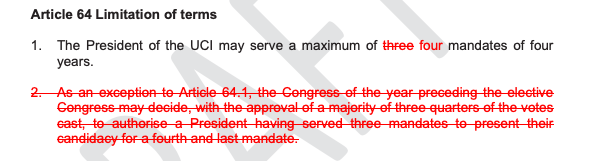
However, the broad wording of that introduction did not disclose the specifics around UCI presidential term limits that were introduced in the latest variant of the Constitution. Article 64 of the latest UCI Constitution now reads that “the President of the UCI may serve a maximum of four mandates of four years” – an extension of four years.

The previous version of the constitution specified “the President of the UCI may serve a maximum of three mandates of four years,” with a clause (Article 64.2) that a president can present a candidacy for an additional term “with the approval of a majority of three quarters of the votes cast” at the Congress preceding the election.
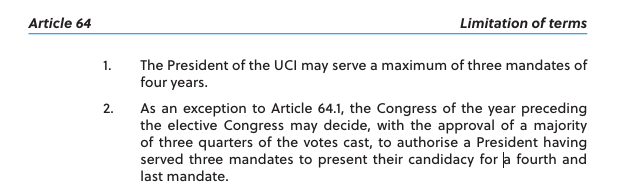
These rules are still listed as current on the UCI’s Electoral Processes page, and represented a much-lauded shift in the UCI’s electoral integrity when introduced in 2016 by Lappartient’s predecessor, Brian Cookson.
When contacted for comment, the UCI confirmed the constitutional change and removal of Article 64.2.
The process and the president
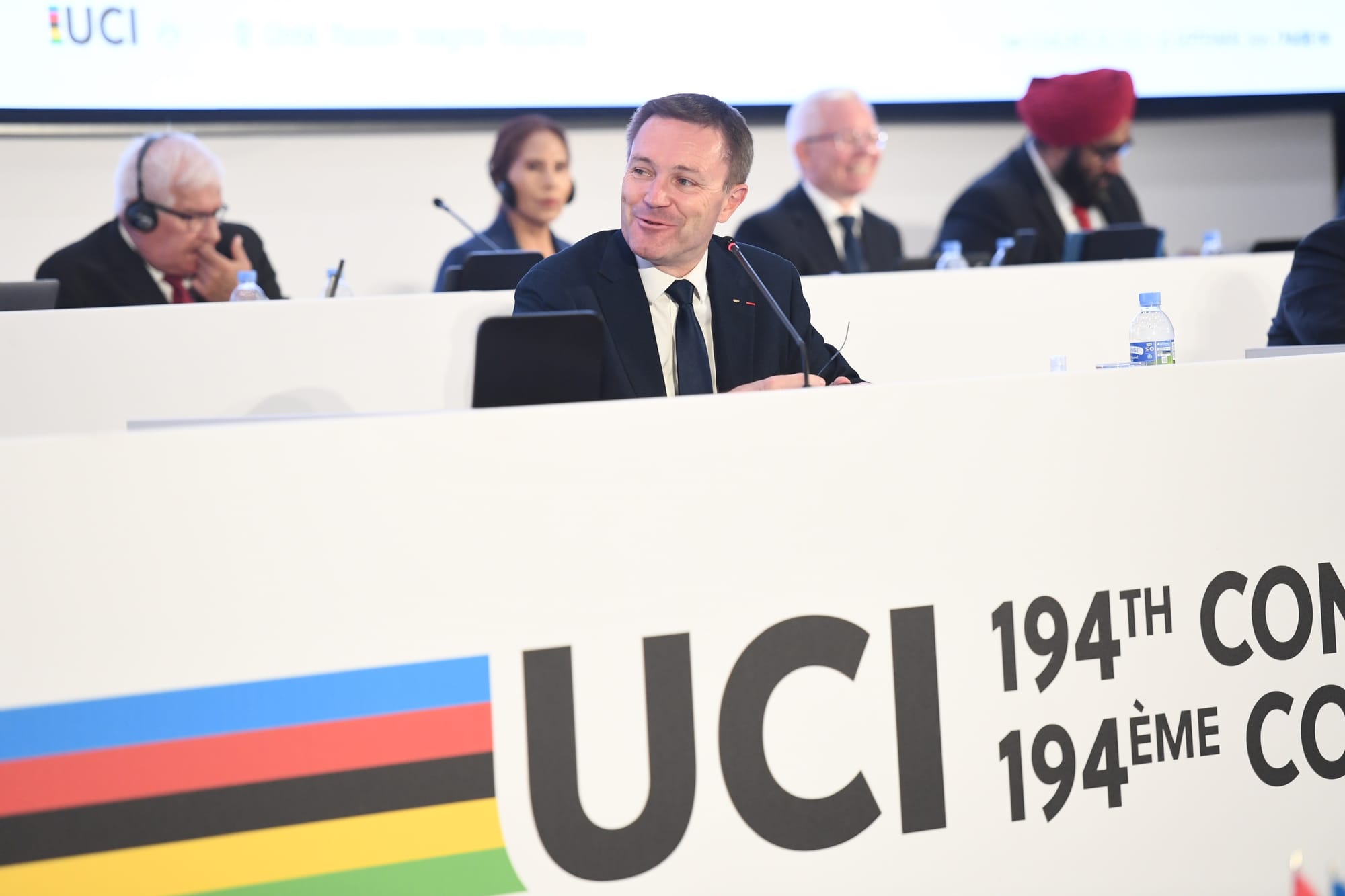
Lappartient was elected for a third – and what was widely presumed to be a final – presidential term at the 2025 UCI Congress. He was the sole candidate. With these changes to the Constitution, a notable barrier to his candidacy for a fourth term – which would last until 2033 – has been removed.
There are question marks, however, over the transparency of the process that led to this point. Escape Collective contacted a number of senior figures across three continents involved in cycling governance, all of whom said they were unaware of an extension to the presidential term limits. They had, sources said, not been disclosed in management committee agendas or press releases in the lead-up to the 2025 Congress.
A slide at the UCI Congress stated that national federations were supplied with “full text of the UCI Constitution with amendments marked” and an “explanatory note on the proposed amendments” in the UCI Congress file, a 200-page document provided to delegates and federations. Escape Collective has reviewed this file, and can confirm that this documentation is provided in full, some 70 pages deep.
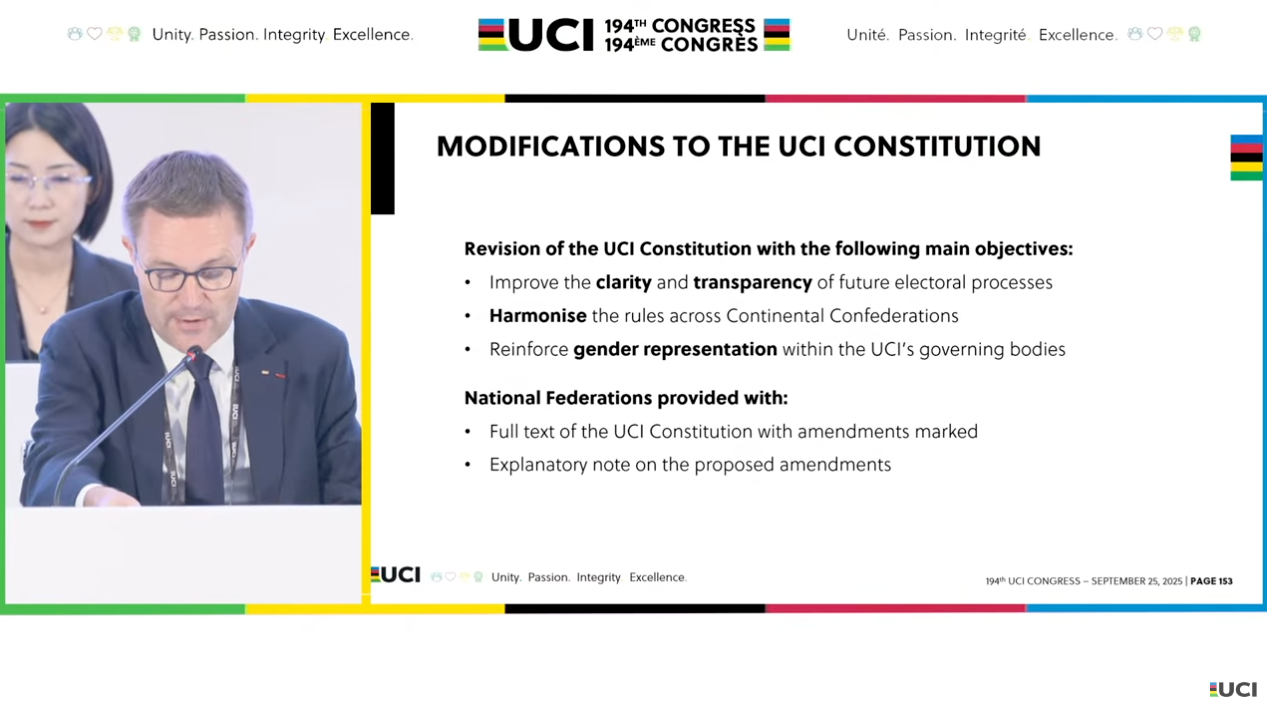
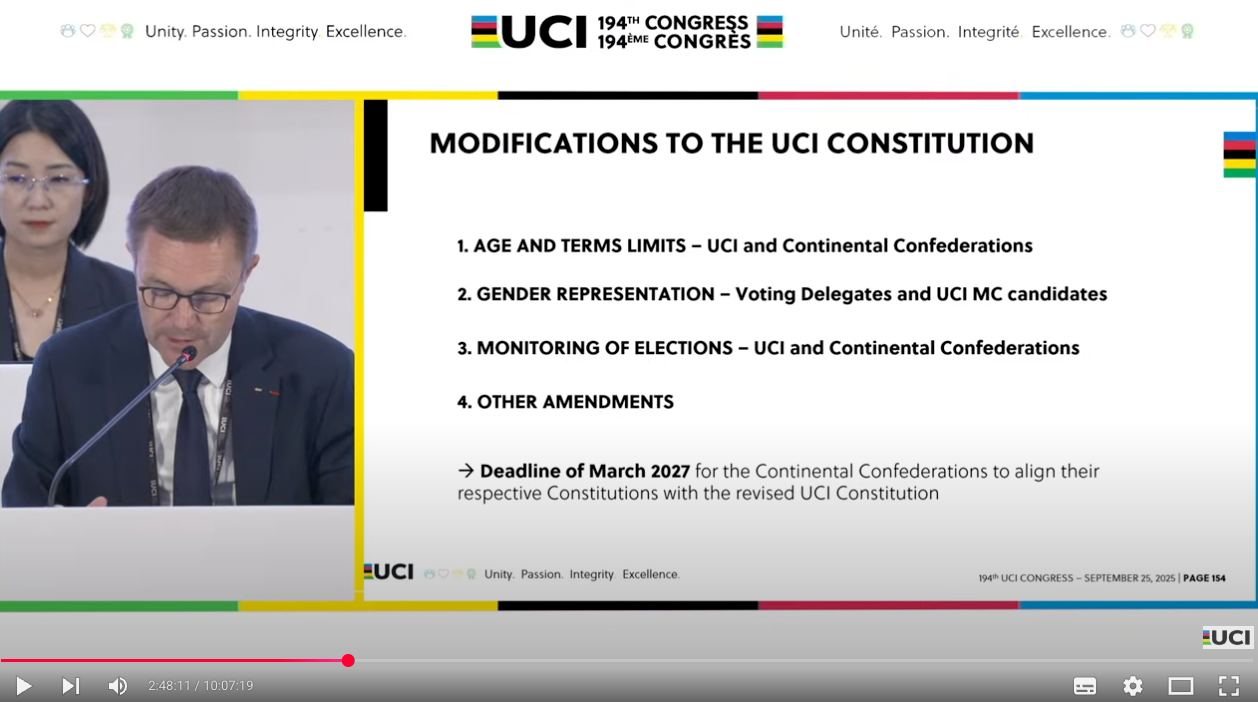
However, the section of the Congress presentation in which constitutional amendments were addressed lasted for just three minutes of a 10-hour whole. No specifics around what the changes to the presidential term limits constituted were mentioned in Lappartient’s comments to the Congress, which quickly moved on to a vote on the proposed amendments (as well as a request for questions, votes against, and abstentions) that was covered in just 10 seconds. According to documentation seen by Escape Collective, the vote was passed with a 100% majority.
The previous constitutional articles around term length (a three-term limit) were introduced by previous UCI president Brian Cookson in 2016, in moves that were described by AAP at the time as “the headline item in a package of reforms to the UCI’s constitution”. Pre-Cookson, there were no limits on duration of a UCI presidency. A UCI press release at the time touted these changes as a “very important step towards ensuring the very highest standards of good governance at the UCI” that, Cookson said, “is in line with international best practice and will help to reinforce the UCI's credibility within the international sports community, as well as with all our stakeholders.”
Escape Collective understands that the constitutional changes for the 2025 amendments were voted on by the UCI Management Committee at a June meeting to widespread approval. It was not, however, listed as an action point in the June meeting agenda, and there was no mention of constitutional changes in the detailed press release issued after that meeting. The changes were also not disclosed after the fact in the press release summarising the 2025 UCI Congress.
Ambiguity begone
Nonetheless, the constitutional changes have been defended by a Management Committee member Escape Collective spoke to as having “removed ambiguity” around presidential term limits. “You could serve four terms previously,” the Management Committee member told us. “It doesn't stop the democratic, fair and open process of being able to run for president.” This constitutional change, they argued, is “minor” and that the larger shifts were around gender diversity and electoral fairness at the continental confederation level.
That’s a valid point, as there have been contentious elections at the Continental Confederation level over recent years – notably around the presidency of the Confederación Panamericana de Ciclismo (COPACI) which has been led by the same president, José Manuel ‘Pepe’ Peláez Rodriguez, since 1991. Peláez won the 2025 election to continue as COPACI President for a ninth term, despite confusion around his age eligibility and the fact that the current COPACI Constitution mandates a maximum of three terms (with the possibility to extend for a fourth term).
The Pan American Cycling Confederation (Copaci) elected Cuban José Peláez as president of the organization for his ninth consecutive term in Panama. pic.twitter.com/ioVNSEbMpE
— Embacuba Sierra Leona (@EmbaCuba_SLeona) February 26, 2025
There are similar inconsistencies across other continental confederations, too. The Asian Cycling Confederation (ACC) has a maximum limit of two terms for its president, while there is no maximum term expressly specified for the Oceania Cycling Confederation (OCC) presidency with it defaulting to the UCI Constitution. To round out the list, there appears to be no publicly available constitution for the African Cycling Confederation (CAC), which has a website without any information on its governance, members, activities, or, for that matter, much else.

The latest constitutional changes are, it seems, a bid to address these inconsistencies. “The Ethics Commission has been a key part of the election process for the last two cycles,” OCC President Tony Mitchell told Escape Collective, with this shift creating greater transparency and oversight as a result. The constitutional changes, then, could help enforce some consistency across the board, with each continental confederation given a deadline of March 2027 to align their stances with the latest UCI constitution.
What of Lappartient?
While there are evidently inconsistencies and loopholes to close in cycling’s governance across many continents, there is a sense from several individuals Escape Collective spoke to that there are also valid questions to be answered about what could seem to be a consolidation of UCI president Lappartient’s power. The Frenchman has led the organisation since he surprisingly ousted Cookson at the 2017 election, and has since made no secret of his ambitions both in the sport and beyond it.
Through his role at the UCI, he has become increasingly influential in the highest echelons of sports governance, becoming a member of the International Olympic Committee (IOC) in 2022. He is, the IOC website notes, “eligible to be re-elected as an IOC Member as long as he remains president of the UCI and until he reaches the age limit of 70 in 2043”.

Earlier this year, Lappartient stood for election as IOC president, losing out to Kirsty Coventry, who will occupy the role for an initial eight-year term, set to end in 2033. For Lappartient to challenge again for the IOC presidency, he needs to remain UCI president until then – something that this year’s UCI constitutional changes have just made slightly easier. And until then, there’s a tidy incentive accompanying his role in Aigle – a package that rose to 557,000 Swiss Francs (€603,000 / US$700,000 / AU$1.078 million) last financial year, with an additional 125,000 CHF for travel expenses. And that’s just one of his roles.
Great to share a convivial moment with the @UCI_cycling and @WCC_cycling employees!
— David Lappartient (@DLappartient) October 15, 2025
Grateful to celebrate my re-election as UCI President alongside Enrico Della Casa, UCI Vice-President, and @Amina_Lanaya, UCI Director General.
🤝 Here’s to teamwork and passion for cycling! pic.twitter.com/ZLQgcFh6dw
With Lappartient currently enjoying broad support from the management committee and voting delegates, without a single opposition candidate in the last two UCI elections, his place at the head of international cycling seems set to continue for a good while longer.
And after that? We’ll just have to wait and see.
Did we do a good job with this story?