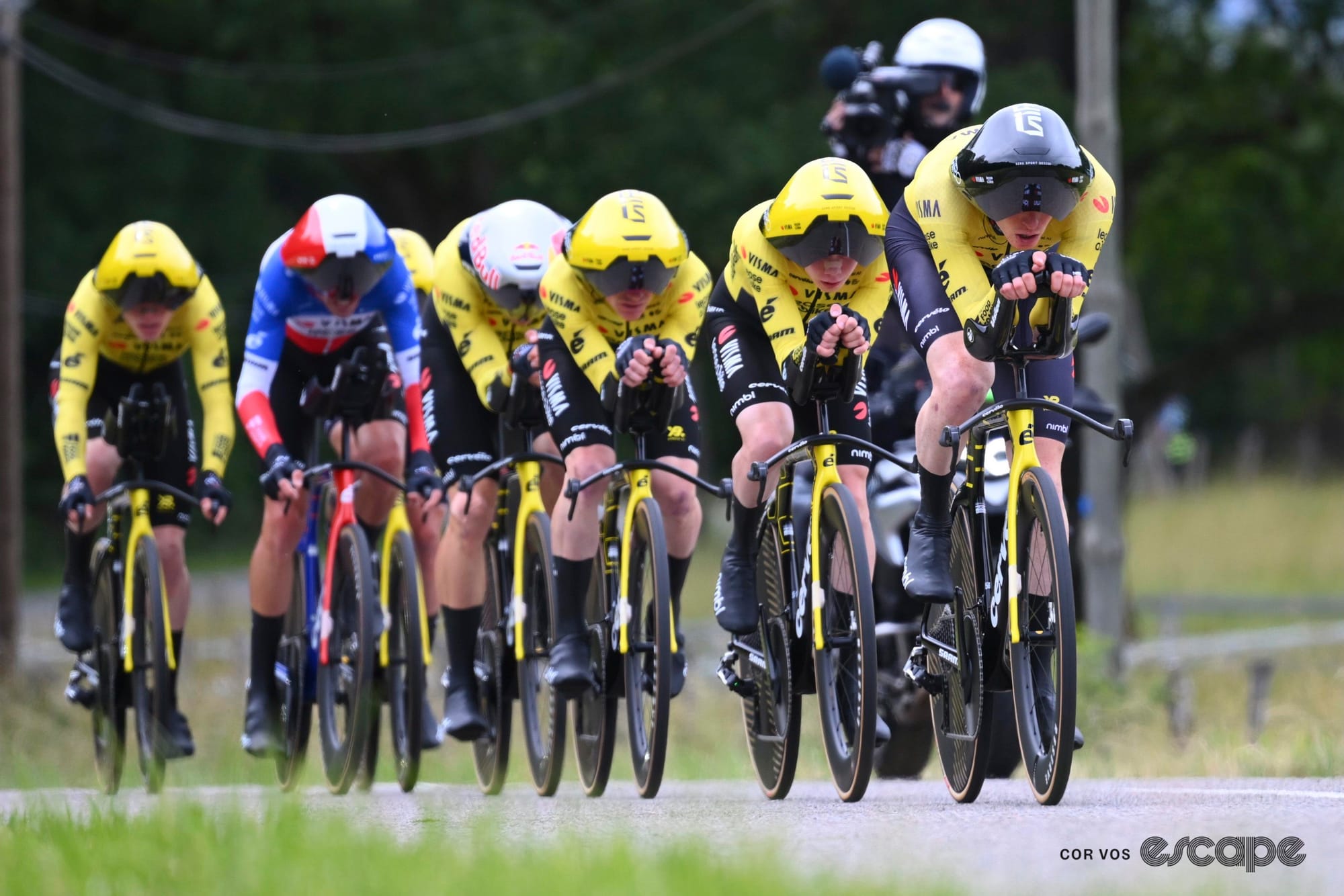

The first yellow jersey of the 2026 Tour de France is on the line on Saturday, and the rider who pulls it on after stage 1 will have just benefitted from a display of coordinated teamwork rarely found elsewhere in pro cycling. Saturday is team time trial day, a unique event with a relatively new format. Who does it well? Who doesn't? Let's break it down.
The new format
Team time trials to this point have taken the finishing time of the fourth rider across the line for each team, which required certain pacing and tactics to keep the majority of the team together. The ASO, the organisers of the Tour de France, changed the format for this year’s Tour de France, taking individual rider times. That means there is no longer a requirement to keep the team together.
Two ASO stage races this year have tried the new format, Paris-Nice and Tour Auvergne-Rhône-Alpes. Those two practice runs give us just enough information to speculate about how stage 1 of the Tour de France will play out.
Racers faced a longer and hillier TTT at the Tour Auvergne than they will at the Tour, but it was close enough to give a window into the strategies teams could use at the Tour. Both have a short, roughly 1 km climb to the finish. The teams that performed the best had many of the traditional ingredients for TTTs, tight team formation, quick pulls, everybody in the aero extensions as much as possible.
The common thinking around the new format was that a leadout into the bottom of the climb, launching the GC leader would be the fastest strategy. So far, that has turned out to be partially true.
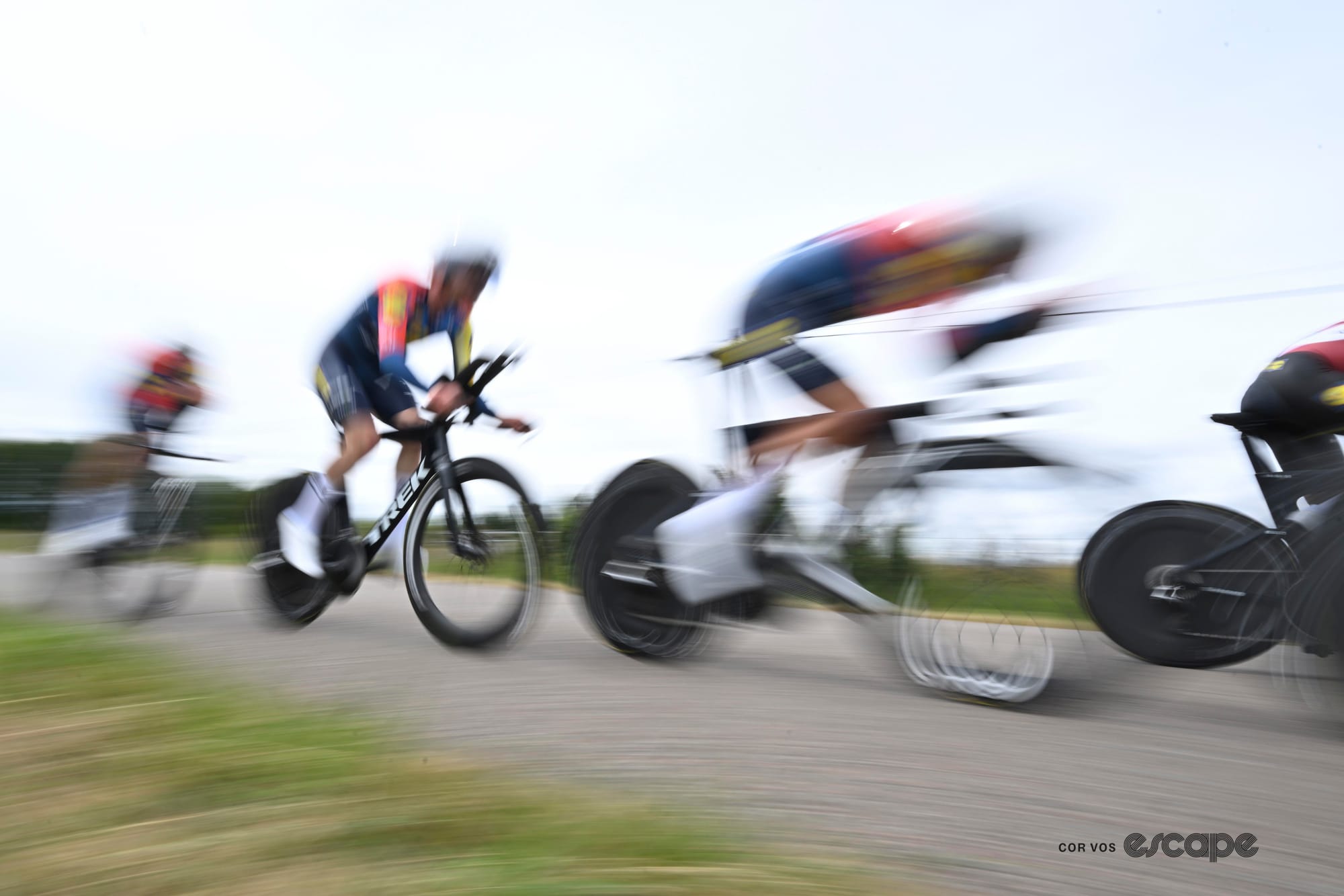
Visma and Ineos, the top two teams in the Tour Auvergne TTT, kept more riders in the group to the bottom of the climb than many were expecting. Even though there was a sharp corner at the bottom of the hill killing the speed, the extra riders helped keep the speed high for the first half of the climb.
Going into a climb at 60 km/h, if the GC leader goes from an aero tuck to hands on the base bar, stands up, and punches into the hill, the wind and the ramp are going to kill his speed. Visma and Ineos kept the speed high into the climb, allowing their leaders to sit in and follow a wheel as long as possible.
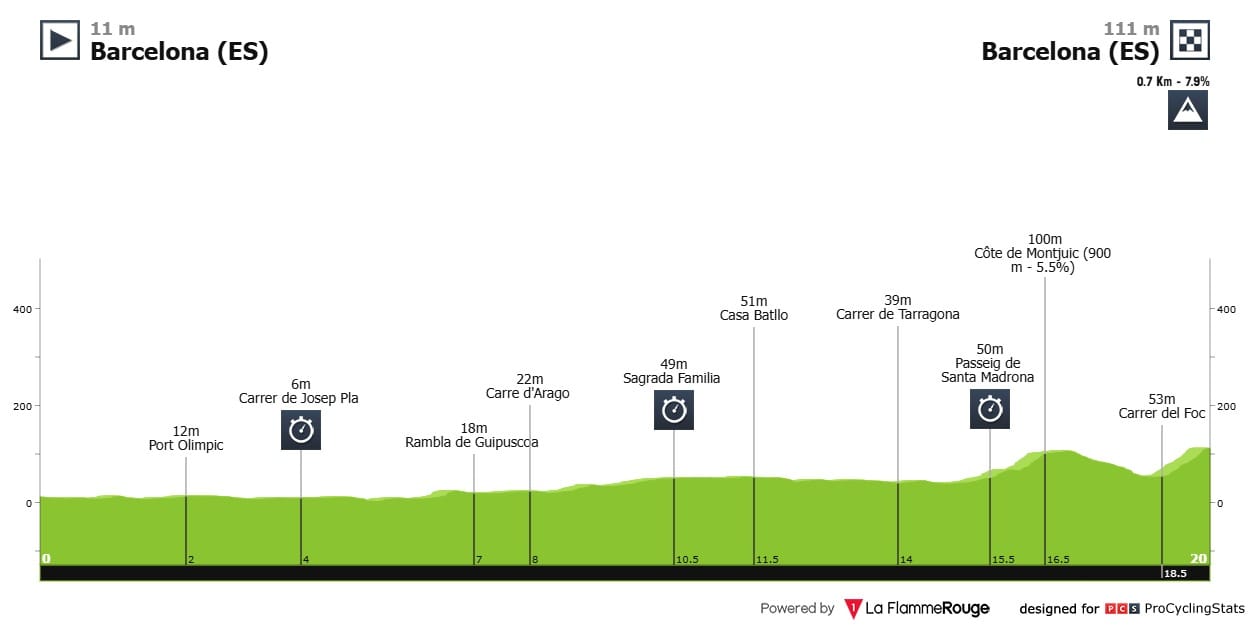
The Tour de France TTT starts with 15 km essentially flat, at which point teams roll into a single km at 5.5%, followed by a false flat downhill for 2 km leading straight into the final climb of 700 m at 8%.
Who has it dialed?
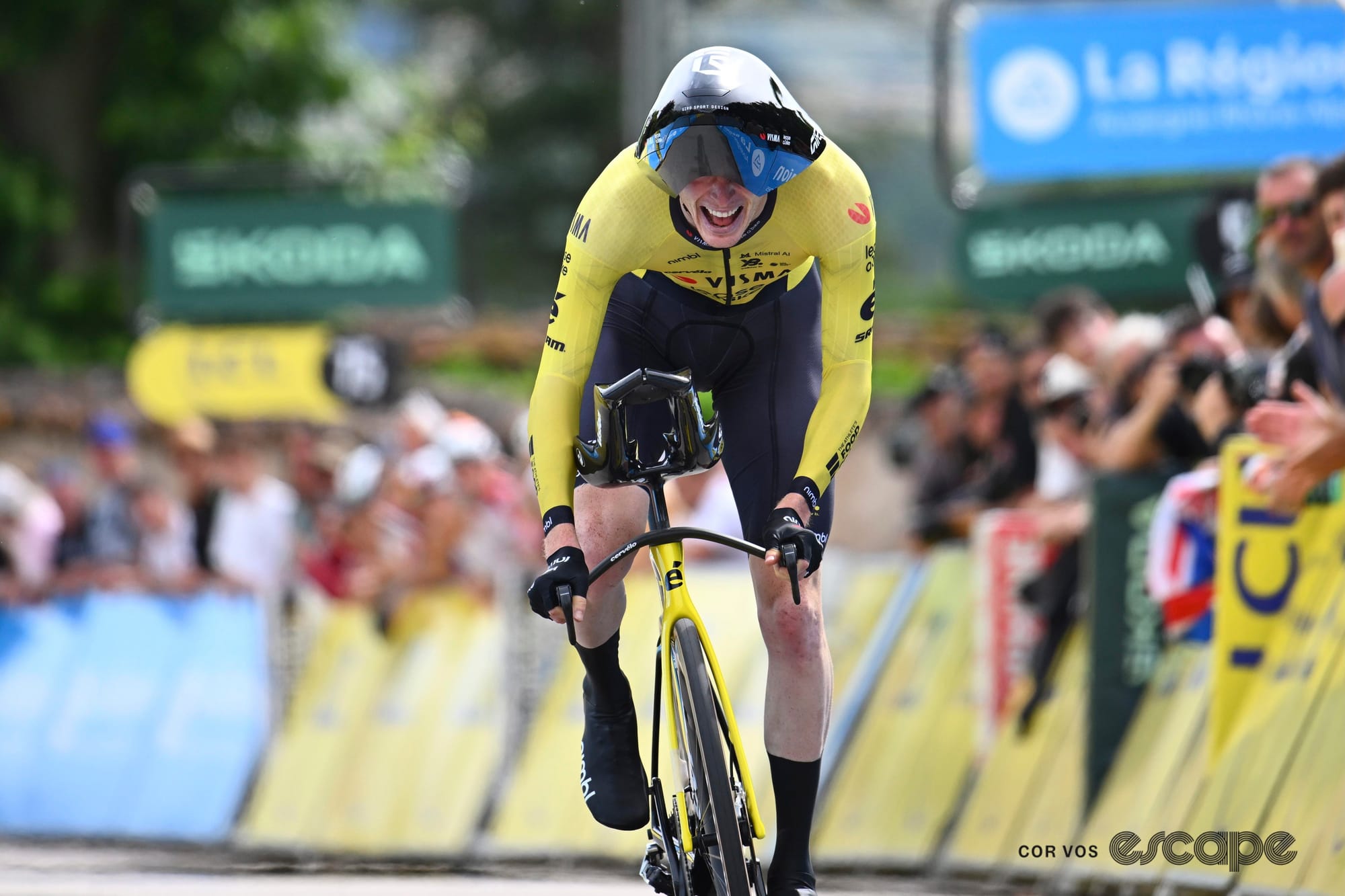
Visma Lease-a-Bike won the TTT at Auvergne with Matteo Jorgensen. They had a far from perfect day, losing Wout van Aert early in the stage and Ben Tullet flatting. Even so, they kept the formation tight. Every time the broadcast cut to Visma, the entire team was in the aero extensions, rotating like a clock.
Visma’s Tour roster is focusing more on support in the mountains, but it will be a formidable competitor on stage 1 with Edoardo Affini, Per Strand Hagenes and Bruno Amirail for the flat sections, Jorgensen and Victor Campenaerts for the rollers, with Sepp Kuss and Davide Piganzoli likely trying to hang on for dear life while Vingegaard stays as fresh as possible for the climb.
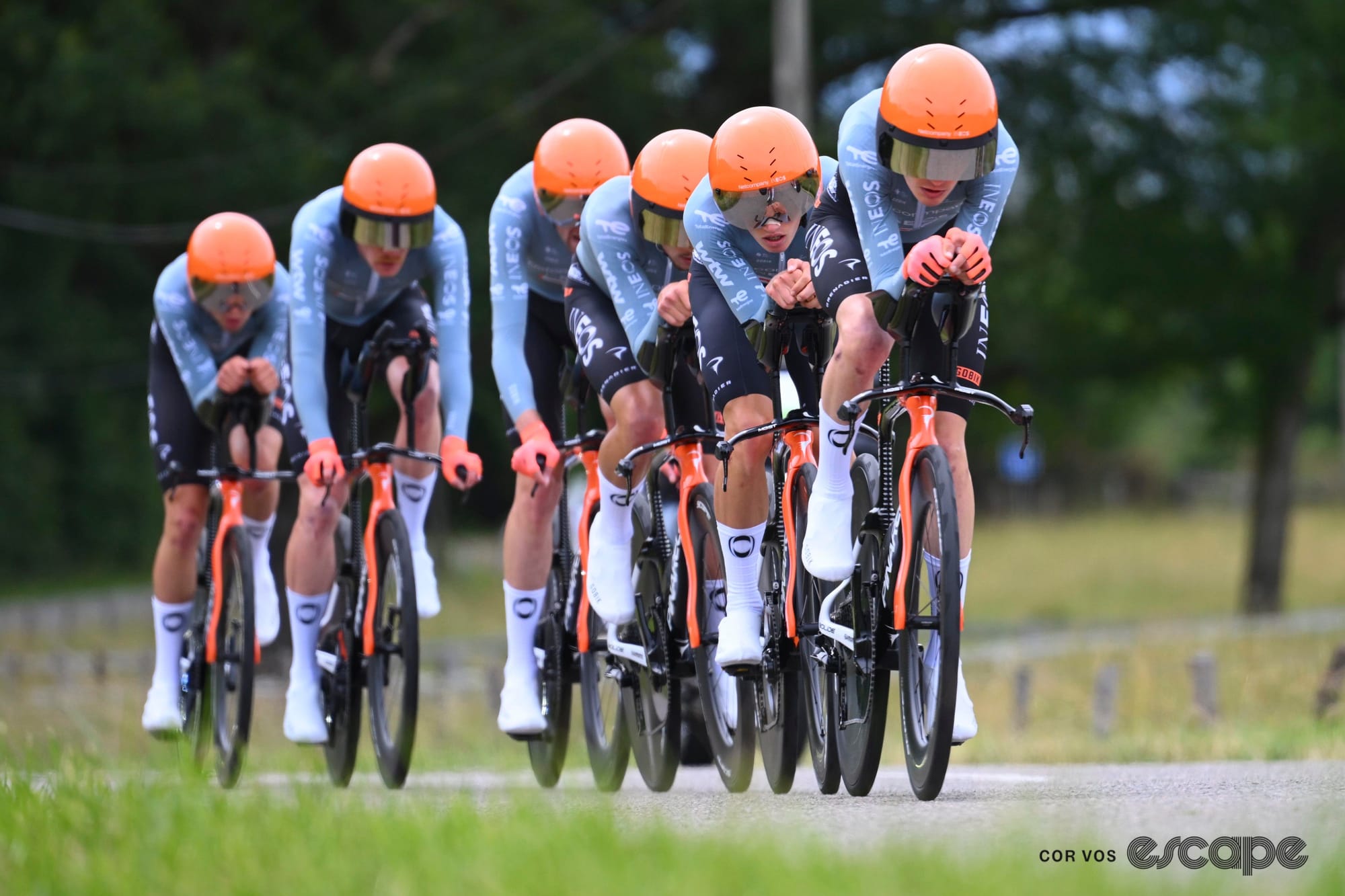
Netcompany-Ineos won the Paris-Nice TTT and might have won Auvergne if they didn’t have two riders drop chains. Their Tour squad is very TTT-heavy with Josh Tarling, Filippo Ganna, Tobias Foss, and even Dorian Godon for the flat, plus Michał Kwiatkowski and Egan Bernal to keep the GC leaders protected as far into the climb as possible, and protected riders Kévin Vauquelin and Thymen Arensman to push each other up the climb. Assuming their chains stay on, Ineos has to be the favorite here.
 Dane Cash
Who needs to step it up?
Did we do a good job with this story?