

I went to Paris for the first time with my wife not long after we were married. I had never been. She had lived there for a few months in her younger days. We are going to Paris, she said. I did not argue. It was the easiest decision of my life. We stayed in Belleville, atop a long, long hill, in an apartment with blue shutters, its entrance on a cobbled sidewalk. The first night, we ate bread and fruit and cheese, purchased quickly from a market down the street. The window was open. Light breeze beneath the eaves. The screams and shouts of children playing, far off into the night. The pattering of feet hurrying themselves into a run. That week, I traded the one dollar tall boys of Arizona Iced Tea for the single-euro baguettes of France. I didn’t know how to judge what made one croissant better than the next. Every croissant was the best croissant I’d ever had.
We walked everywhere that week. We’d leave the apartment at nine in the morning and come back at nine at night. We’d walk down the long, long hill—past the woman who sold ceramics out of her window, past one boulangerie, then another, then another. Sometimes we’d walk northwest, into Parc des Buttes-Chaumont, where a bridge suspended out of seeming-nowhere over a moat of water. We’d walk deep into the city from where we stayed, through the Marais, across the Seine, into Saint-Germain-des-Pres, through bookstores stocked with books whose covers were immaculate, typeset squares, and then back across the Seine, into the Tuileries—the garden of perfectly manicured trees. We looked out of the big clock at the top of d’Orsay. We found ourselves surrounded, once, by an entire wall painted by Monet. We ate falafel—the center of which was so bright and green I would’ve mistaken it for meadow-grass under a spring sun—at the counter of a Lebanese restaurant in the Marches des Enfants Rouges. And then we climbed up to Montmarte, where, in a square lined with cafes, a few dozen artists sketched, in gentle, airy strokes of lead, the faces of those that sat across from them.
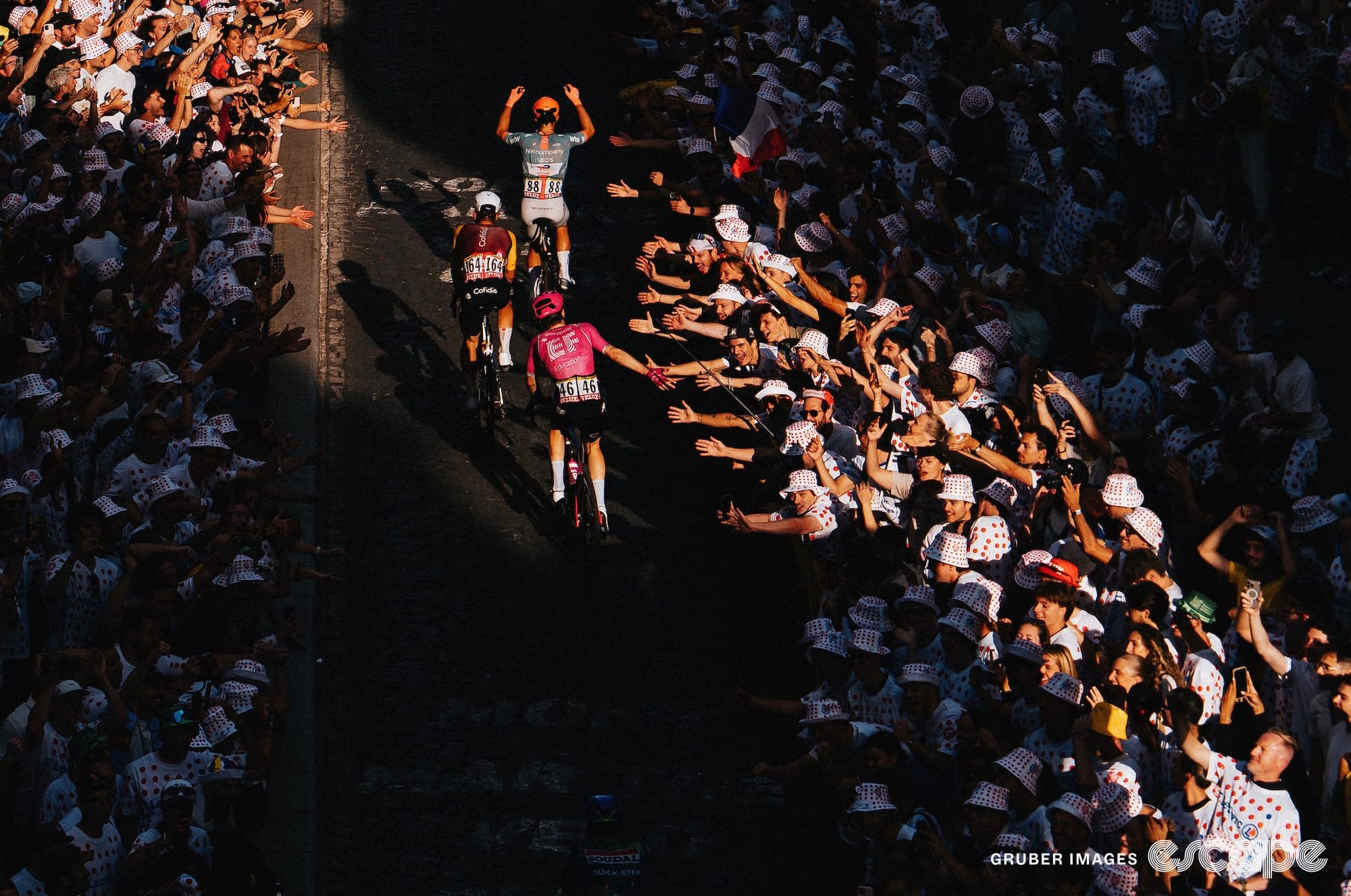
On Stage 21 of this year’s Tour de France, people lined those same cobbled streets climbing toward that same cathedral on a hill. They lined them eight, nine rows deep. They leaned out of doorways. They stood with one arm on a window’s ledge and the other arm outstretched. On the steps leading up to Sacré-Cœur, as if a Sunday mass were facing outwards, an entire congregation gathered to witness the riders ache and push and pull themselves up the neighborhood. When Tadej Pogacar attacked on the second ascent of that sacred climb, hammering into the bend on Rue Lepic, every person with a mouth let out the loudest scream on earth. I watched from thousands of miles away and felt my own teeth shake.
Did we do a good job with this story?