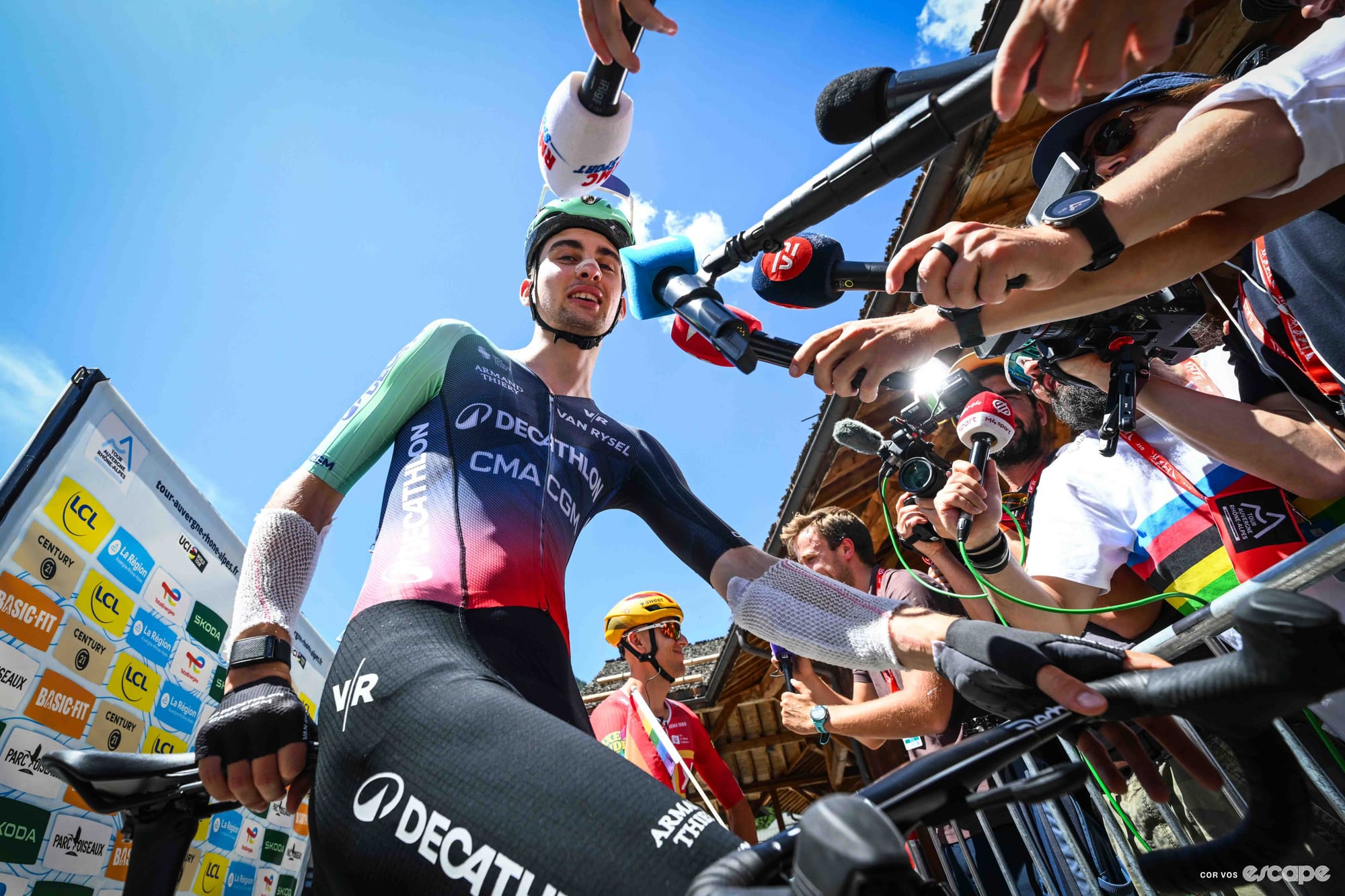

Paul Seixas. The boy wonder, the one true king of France. He is just 19 years old but came as close as anybody in years to matching Tadej Pogačar at Liège-Bastogne-Liège and Strade Bianche this spring. Less than two weeks out from the Tour de France, the hope is immeasurable, and the pressure is immense. Our bag of mail is bursting at the seams.
Over the past few weeks, we asked Spin Cycle listeners and Escape Collective members to send in their Seixas-themed questions. This week, three of our Tour de France journalists, Jonny Long, Kit Nicholson, and Caley Fretz, sat down to answer them. What follows is that conversation, edited considerably for the page.
To listen to the full episode, become a member.
Paul from Instagram: What does a successful debut Tour look like for Paul Seixas? Is it flashes of brilliance, or does the French public need more?
Kit Nicholson: There are different expectations depending on who you ask. What does he expect, what does the French public expect, what does the team expect? I'm going with what he and the team expect, because the French public ... can't be trusted. When it comes to cyclists, it's true.
Paul, in his own head, wants to win the damn thing. But I think the team will be hoping for a top five or a stage win, anything else on top of that, because of who else is going to be there – not least Isaac del Toro. If we imagine Pogačar and Vingegaard are going to be on the podium, Del Toro is a very good extra presence there. And then you've got the Red Bull pair, Evenepoel and Lipowitz. There are at least five very, very good GC prospects going to this Tour de France. Top five, they ought to be jolly happy with that.
Caley Fretz: We're recording this shortly after the Tour de Suisse wrapped up, where Lenny Martinez – more of a minor French hope at this point — got overhauled by Pogačar in the final 800 metres. That will have done further emotional damage to the French public, and I think they're going to be demanding in July.
In their hearts of hearts, they know this is a young man. They know it's probably too early to set expectations too high. But if we come into the first rest day and he's there or thereabouts, the expectation is going to start to ratchet up. We have a relatively easy first 13 days of the Tour this year. Despite it going to the Pyrenees almost immediately, a lot of those stages aren't where things are going to fully explode. So it's a reasonable prediction that Seixas could be somewhere in the top 10 at that first rest day – and I think that ratchets the expectation up even further.
 Caley Fretz
Until he actually falters, the French public will believe he could be third on the podium. I don't know how rational that is, but... if there was a young American rider of similar exceptional talent, I'd be looking at it going, yeah, maybe. Like some American soccer fans are doing at the World Cup right now.
Kit: There is a vocal community of French sports fans — there's even a federation, La Fédération de la Lose, who champion riders like Thibaut Pinot, who had great success but also suffered a lot. Coming second to Pogačar was actually disappointing to them. There's this funny dichotomy in French cycling that seems to actually love the David Gaudu types; riders who falter more than they succeed.
Caley: If he loses heroically, the expectation into next year just goes up.
Jonny Long: Part of his story is going to be how he copes with what Pinot and Bardet, to an extent, couldn't.
Joey Lopreiato: What explains the sudden wave of under-23 talent skipping years of seasoning? And if Seixas faces a rival named Seixas — his brother – in 2032, is it the Battle of the Seixes?
Caley: It's across the board in other sports too. I think it comes from a lot of different things – we did some reporting around this, talking to coaches and folks running development teams.
Did we do a good job with this story?